
As Seen In


If This Feels Familiar, You’re Not Alone

You have decades of experience, yet fewer interview calls

Recruiters say you’re “overqualified” but don’t explain why

The rules of hiring seem unclear and constantly changing

You’re confident in your skills—but unsure how to position them
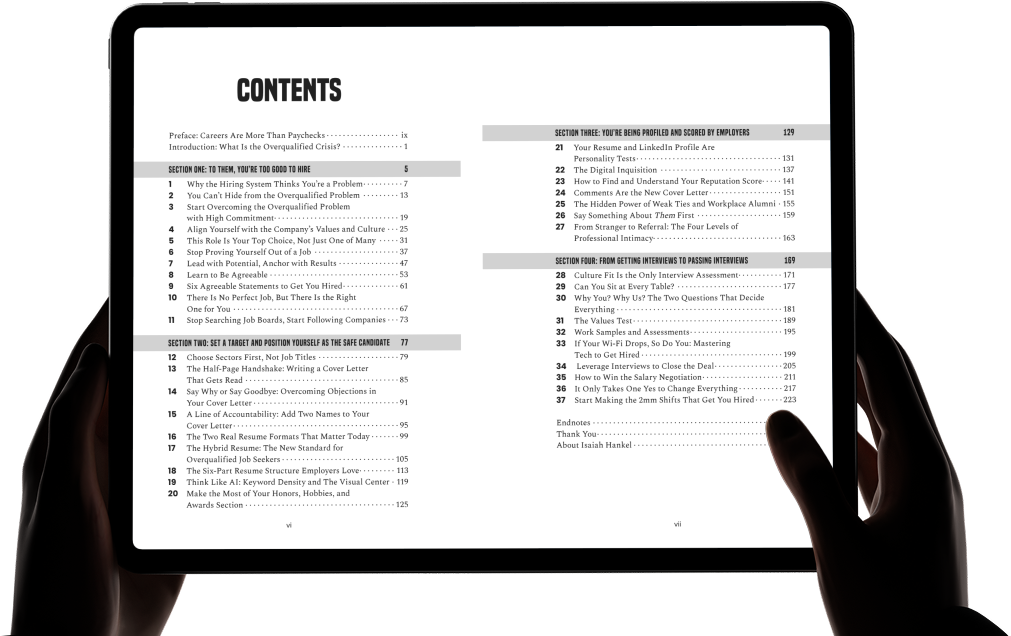
Understand Why Employers May View You As Overqualified.
Recognizing The Signs Can Empower You To Navigate The Job Search Process More Effectively.
Is This Book Right For You?
This Book Is For You If:

You are a senior executive or leader with 15+ years of experience
You hold an MBA or Advanced professional background
You want thoughtful guidance—not shortcuts or hype
You value clarity, strategy, and long-term relevance


This Book Is Not For You If:

You are looking for quick fixes or generic job advice
You prefer trend-driven or purely motivational content
You are early in your career
About The Author

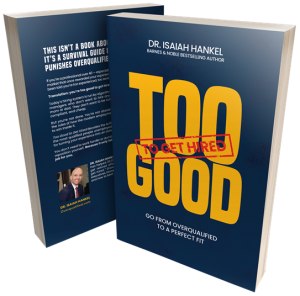
Isaiah Hankel
Founder and CEO of OverqualifiedTM
Isaiah Hankel
Founder and CEO of OverqualifiedTM
What This Book Will Help You Do
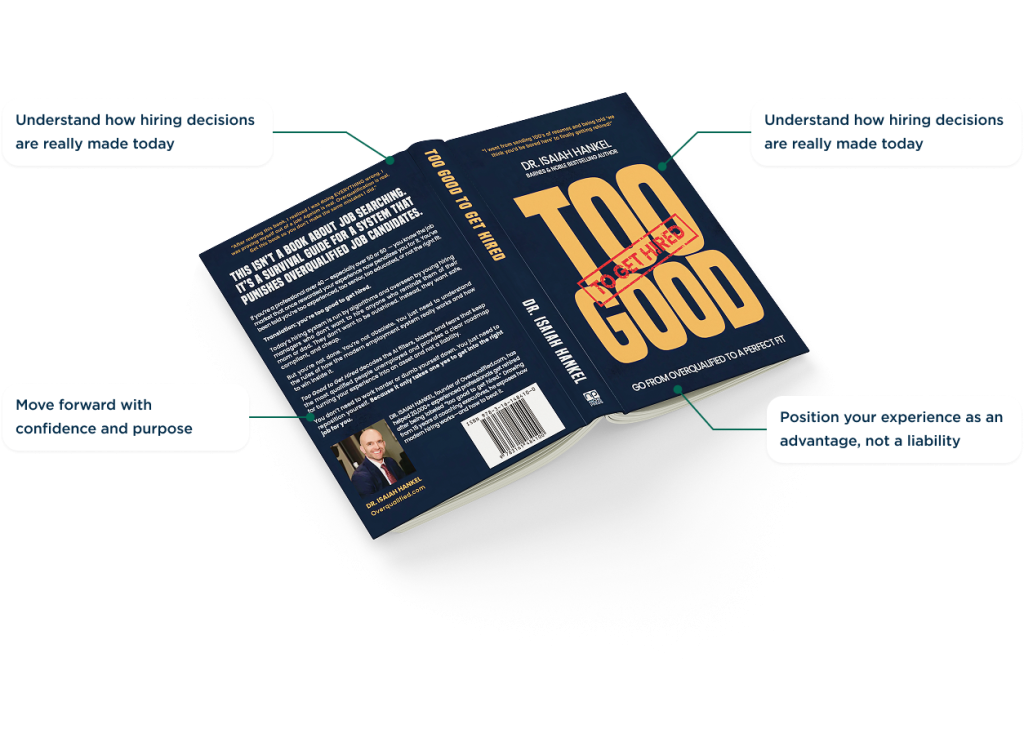
Understand how hiring decisions are really made today
Understand how hiring decisions are really made today.
Move forward with confidence and purpose
Position you experience as an advantage, not a liability
What Readers are Saying

I ended up getting 3 offers and took one as a manager. Had to turn down 2 interviews because too many replies coming in at once. I couldn’t believe it. So thrilled! Doing great and thanks again for your help and awesome program!


Steve Combs
“I am thrilled to share that I am starting a new position… my sincerest thanks and gratitude to all the inspirational people who’ve I met along the way in my journey who helped make this happen.”

Leandra Mangieri
I accepted my job offer today. I was able to get 5k more + the exact PTO package I wanted. I am very happy and very thankful for everything that I learned through the event.I plan to stay involved with the program as I love what y’all are doing.

Tracy Gardner
Quotes From The Book
Being called overqualified is not a reflection of your value; it’s an excuse. It’s a euphemism. A subtle but effective way of saying: you’re not wanted here.
You cannot afford to sit this out. You cannot afford to wait for something to ‘come along.’ Because the longer you remain out of a high-quality job, the harder it is to convince others — and yourself — that you belong in one.
If you had fewer qualifications, you wouldn’t have to work this hard to prove your interest. But because you bring more to the table, you have to offset the assumption that you’re only here temporarily, or worse, that you’re settling
You’re not getting rejected in spite of your credentials. You’re getting rejected because of how you present them.
Employers are afraid of hiring someone who’s “done.” They want someone with momentum. Someone they can bet on. Someone who, if nurtured, will do their best work here and now, not just somewhere else, years ago.
When you’re overqualified, you’re a bigger question mark than the other candidates. Will you stay? Will you respect their leadership? Will you adapt? Likability erases those doubts. It gives you a competitive advantage.
Smart job candidates don’t just ask for more; they show why they’re worth more in terms that the employer cares about: being agreeable, dependable, adaptable, and able to deliver results beyond the stated role.
Someone is getting hired today who has less experience than you, fewer results than you, and less to offer than you. They got the yes because they were in the right place at the right time, and they kept showing up until the timing aligned. That can be you, if you keep showing up
Employers take the path of least resistance. They pass on the most capable candidates, not because they doubt their skills, but because they fear their motives.
The hiring system doesn’t fear your talent. It fears your exit. It sees you as a flight risk.
Overqualified candidates are more likely to be hired over other applicants, if and only if they make it clear that the role in front of them isn’t just acceptable, it’s preferred.
Talent alone is not enough. You have to prove that your talent will integrate with a company’s existing culture.
Employers are making bets. They’re trying to predict who’s going to stick around. And they know from experience that the candidates who seem ambivalent, who talk vaguely about ‘next steps’ or ‘broad interests,’ are the ones most likely to disappear when a shinier offer appears.
You can’t just prove yourself anymore. But you also can’t just posture. This is the paradox facing every highly qualified job seeker: you’re expected to show potential, not just performance, but you’re also expected to be credible, trustworthy, and real.
Will I get fired by hiring you?’ is the question ringing in the hiring manager’s ears when you walk into the interview room. If you think they care about your credentials more than their own survival, you’ve already lost.
The person who wins in this job market is the one who stays in the game long enough to find the right match. The one who understands that a “no” is just a data point, not a verdict. The one who sees every conversation as a bridge to the next opportunity.